
ZK-Proven DEX Incentives: Smart Incentivization for Traders
Most DEX incentive programs distribute the same rewards regardless of market conditions, user quality, or ecosystem health. This isn't a design failure; it's a technical constraint. Smart contracts are deterministic and sandboxed. They can only act only on data that exists onchain at execution time. Complex behavioral analysis (identifying which traders stabilize markets during volatility, segmenting users by contribution type, detecting reward-gaming patterns across wallets, and so on) requires computational operations that are simply impossible to run inside a smart contract.
The result is that "intelligent" incentive design has historically meant choosing between two undesirable outcomes: either you accept a static system that treats all activity identically, or you introduce a trusted offchain administrator who feeds behavioral data into your contracts. The first option is inherently limited. The second breaks the trustless guarantee that makes onchain systems valuable in the first place.
Space and Time's Proof of SQL technology resolves this conundrum. It makes genuinely adaptive, verifiable onchain incentives achievable for the first time.
What Proof of SQL Does
Proof of SQL is a zero-knowledge proof system for SQL query execution. Here's what that means in practice.
Space and Time indexes onchain data (every swap, liquidity event, and fee generation activity across your DEX) into a queryable database. A developer writes SQL queries that analyze that data: rolling volume, liquidity provision during stressed markets, cross-pair behavior, wallet-level patterns, and so on. Those queries run offchain, where complex computation is cheap.
The key step is what happens next. Proof of SQL generates a cryptographic proof that the query was executed correctly on the exact data it claims to have used. The proof is verifiable onchain. That means your smart contract doesn't have to trust the query result; it can cryptographically confirm that the computation happened as specified, on unmodified data.
This is the capability that changes what's possible. Your contract can now act on complex behavioral intelligence without the need for any outside intermediary. The analysis is done where it's computationally feasible; the verification is done onchain where trustlessness is required.
The Intelligence Gap in DEX Incentives
Static Programs in Dynamic Markets
Traditional DEX rewards distribute tokens according to fixed formulas that cannot adapt to changing market conditions. For example, different trading behaviors become valuable during high volatility periods, yet static reward systems continue operating with parameters designed for stable market conditions.
Missing Context About User Quality
Effective trader incentives require understanding user context beyond simple transaction metrics. Professional market makers, retail traders, and institutional participants all contribute value through different mechanisms, but most reward systems treat all activity identically.
Inability to Detect Ecosystem Health
Healthy DEX ecosystems require balanced participation from different user categories, adequate liquidity across trading pairs, and sustainable revenue generation. Yet static reward systems cannot monitor these essential ecosystem health indicators or adjust incentives to address gaps and imbalances.
From Static Rewards to Market-Aware Incentives
Rewards that respond to market conditions. Different trader behaviors become valuable under different conditions. During high volatility, liquidity providers who maintain tight spreads take on significantly more risk and provide more ecosystem value than during calm periods. A static reward formula can't recognize this. With Proof of SQL, you can write a query that detects market stress conditions in real time and feeds adjusted reward multipliers to your contract. Any user can verify the adjustment criteria were applied as documented.
Recognition for different kinds of contribution. Professional market makers, retail traders, and institutional participants contribute value through different mechanisms and at different scales. Building differentiated reward tiers has previously required either crude onchain proxies (wallet age, transaction count) or an offchain administrator making judgment calls. Proof of SQL lets you define precise, auditable behavioral criteria in SQL: for example, consistent liquidity provision across multiple stress periods, trading activity that broadens pair diversity, or volume thresholds that indicate institutional participation. Those criteria are applied onchain with cryptographic verification that they were applied correctly.
Incentives that address ecosystem gaps. A healthy DEX requires balanced participation: adequate liquidity across pairs, sufficient retail volume to validate institutional activity, stable revenue generation. When gaps emerge, you want incentives to respond. With a Proof of SQL-based system, your queries can continuously monitor these health metrics and automatically adjust reward parameters to address imbalances, without manual intervention and without requiring users to trust that adjustments are being made fairly by a centralized party.
Gaming resistance that evolves with the system. Reward gaming typically requires manual detection and parameter changes. Because Proof of SQL queries can analyze complex behavioral patterns (for example, activity clustering, wash trading signatures, and cross-wallet coordination), the system can incorporate gaming-detection logic directly into eligibility calculations. When new strategies emerge, you update the query. The onchain verification guarantee ensures that the updated logic is applied as written.
Smart Contract Architecture for Intelligent Onchain Incentives
An adaptive DEX incentive system built on Proof of SQL has three layers, each with a distinct role.
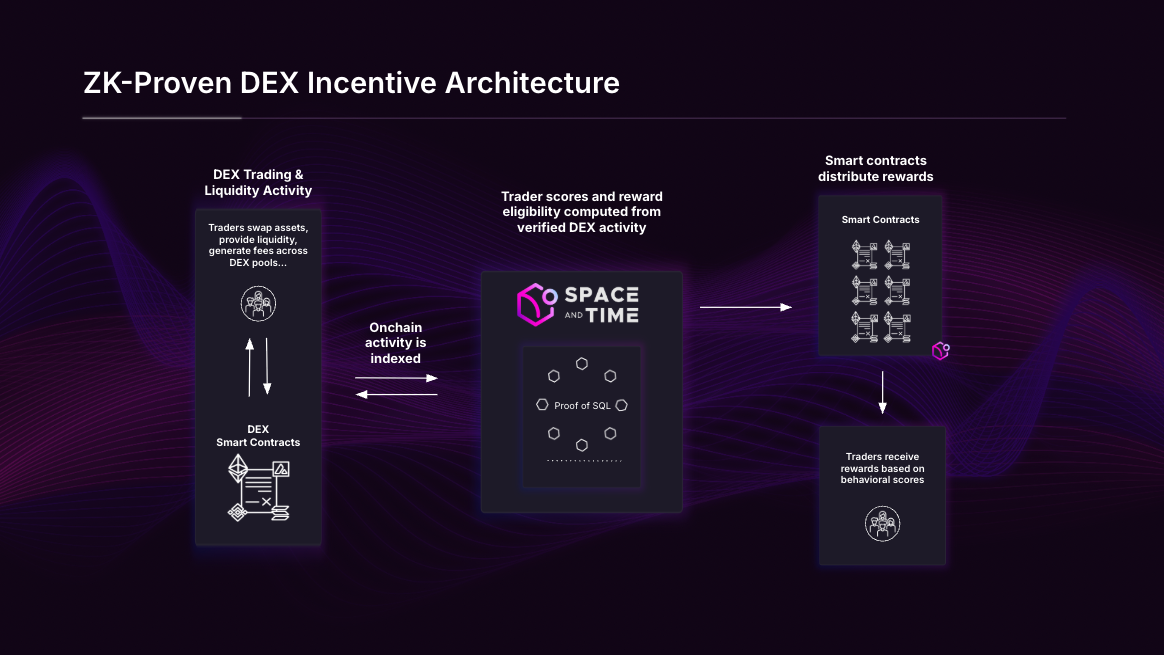
The data layer is where Space and Time ingests and indexes your DEX's onchain activity, e.g. swaps, liquidity events, fee generation, wallet behavior across trading pairs. This indexed data is what your SQL queries run against. You control what gets indexed, by selecting the contracts and events you want to monitor.
The intelligence layer is where your queries live. You write SQL that defines the logic: what constitutes a high-quality liquidity provider, how to detect market stress conditions, which behavioral patterns indicate a genuine retail trader versus a wash trader. Proof of SQL executes these queries offchain and generates a cryptographic proof of the result. This is the layer that makes complexity possible without sacrificing verifiability.
The distribution layer is your reward contract. It receives query results alongside their ZK proofs, verifies onchain that the computation happened as specified, and distributes rewards accordingly. Because the proof is verified onchain, users can audit exactly how reward decisions were made.
The important distinction from a typical oracle setup: there is no need to rely upon a party asserting that the data is correct. Instead, the proof mathematically guarantees it.
Three Steps to Deploy Intelligent Onchain DEX Incentives
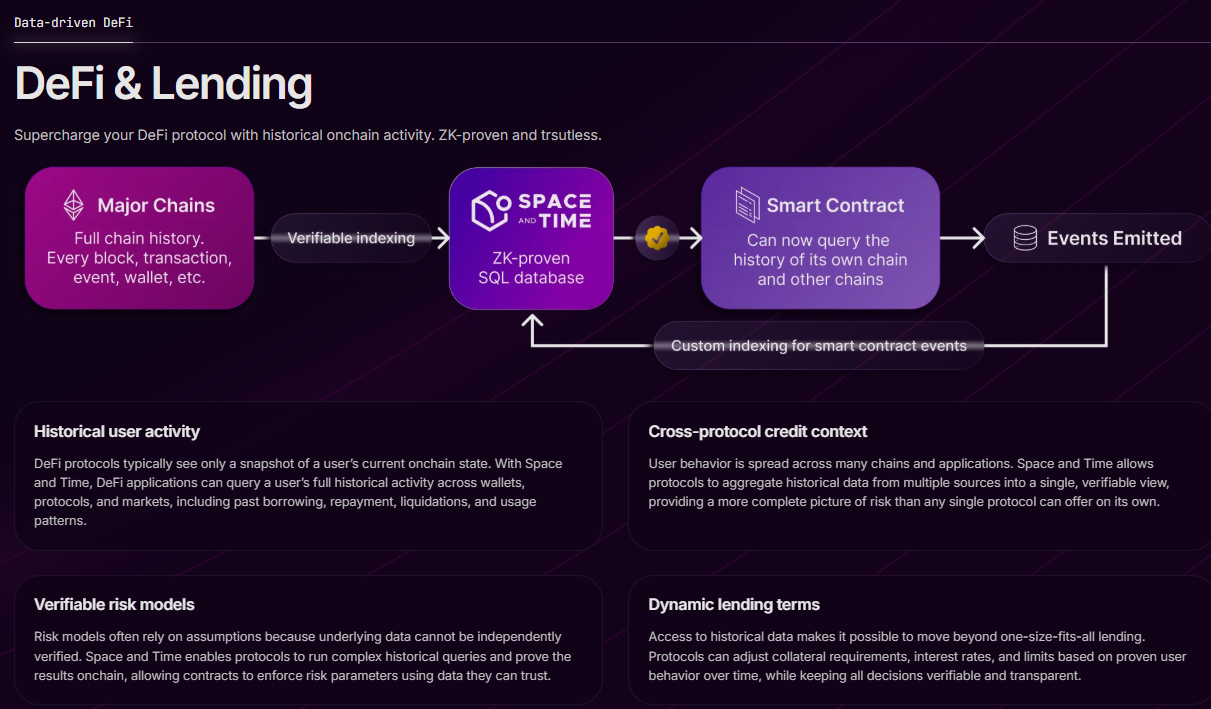
Implementing adaptive trader incentives using Space and Time requires only three simple steps to transform static reward programs into intelligent, market-responsive onchain systems:
Step 1: Index the Necessary Onchain Data
Select the smart contracts and onchain events you want to monitor for trader behavior analysis. Using the Space and Time Studio, simply:
- Choose your DEX contracts: Select the trading pairs, routers, and liquidity pools you want to include in onchain reward calculations
- Pick relevant onchain events: Identify swap events, liquidity changes, and fee generation activities that indicate valuable trader behavior onchain
- Send to indexer: Submit your contract addresses and event filters to Space and Time's indexing system, which automatically begins tracking all selected onchain activity
The indexer handles all the complexity of multi-contract monitoring, onchain event parsing, and data normalization across your entire DEX ecosystem.
Step 2: Configure the Onchain Smart Contract Logic
Set up your reward contract with two key components that define how intelligent onchain incentives operate:
Query for Onchain Eligibility: Define the SQL query that determines trader quality and reward eligibility based on onchain behavior patterns. The query analyzes trader behavior patterns, market conditions, and ecosystem contributions to calculate personalized reward scores for each user, all of it verifiable onchain.
Onchain Rewards Logic: Configure reward multipliers, distribution schedules, and adaptive parameters that respond to query results directly onchain. Set up automatic adjustments for different market conditions, user segments, and ecosystem health indicators that execute autonomously onchain.
Step 3: Deploy and Activate Onchain Intelligence
Deploy your intelligent incentive contract with onchain Proof of SQL integration enabled:
- Onchain contract deployment: Your smart contract automatically connects to Space and Time's query router for continuous onchain market intelligence access
- Onchain reward distribution activation: The system begins automatically distributing rewards based on verified trader behavior analysis and current market conditions, all executed onchain
- Continuous onchain optimization: Your incentive system immediately starts adapting to user behavior and market changes without manual intervention, maintaining full onchain execution
Once deployed, your onchain DEX incentive system operates autonomously, continuously optimizing reward distribution for maximum ecosystem benefit while maintaining transparency and cryptographic security through onchain execution.
For complete technical details on implementing onchain Proof of SQL smart contracts, including code examples and deployment guides, see the full onchain deployment documentation.
The Future of DEX Incentives
Traditional static reward programs mirror the crude early stage of DEX incentive design. As markets become more sophisticated and competition intensifies, intelligent and adaptive systems become essential competitive advantages that enable protocols to maintain optimal incentive alignment regardless of changing conditions.
Space and Time's Proof of SQL technology enables this evolution by providing the market intelligence infrastructure necessary to enable truly intelligent incentive systems that continuously optimize for protocol success.
ZK-proven DEX incentives are part of our broader Trustless Stablecoin Rewards framework.
About Space and Time:
Space and Time provides the onchain intelligence infrastructure that enables sophisticated, stability-focused derivatives incentive systems. Our Proof of SQL technology helps derivatives protocols build intelligent reward programs that automatically recognize hedging value and risk management quality while promoting market stability over raw volume metrics.
