
Economics of the Space and Time Ecosystem
TL;DR
- Space and Time is the foundation of verifiable data that will bridge the gap between offchain financial infrastructure and onchain systems to usher in the future of finance.
- All network value is driven by real workloads, including indexing, data insertion, and ZK-proven queries.
- These workloads consume network resources and are metered and settled in SXT.
- As usage grows, value accrues to the decentralized network through transparent, verifiable economic activity.
Space and Time mainnet launched in May 2025 with live workloads, active participants, and production usage already flowing through the network. With core infrastructure in place and early usage established, the network is now entering its scaling phase.
SXT is the native token that enables coordination, security, and value exchange across a global network of Space and Time participants. For a primer on SXT token utility, economic model, and distribution, see this blog post.
The future of Space and Time
Finance is entering a new phase where the line between traditional systems and onchain markets is blurred. Most financial activity still originates offchain: banks, exchanges, payment networks, asset servicers, and enterprises operate on centralized databases, internal ledgers, and compliance-heavy infrastructure. At the same time, value is increasingly settling onchain through stablecoins, tokenized assets, automated markets, and programmable contracts. Rather than TradFi moving onchain wholesale, or DeFi entirely replacing existing systems, the future of finance is a hybrid layer where offchain systems continue to operate, but their outputs must be provable, composable, and enforceable onchain.
Space and Time, the data blockchain, is purpose-built for this convergence. It’s a decentralized database designed not just to store and serve data, but to prove its correctness. As financial assets increasingly behave like data products, with rules, histories, and states that must be computed rather than assumed, the ability to prove data correctness is critical. Space and Time sits at the center of this transition, operating as a neutral, verifiable data primitive that financial systems can safely depend on.
Economics of the Space and Time ecosystem
With verifiable data as a core primitive of finance, economic activity naturally concentrates around the infrastructure that computes and serves it. In practice, this manifests as sustained demand for data computation and verification. In the Space and Time network, value is created when clients (whether enterprises, institutions, developers, or Dreamspace, a vibe coding canvas for generating onchain apps on the network) use Space and Time services to index, secure, prove, or serve data. Each of these activities consumes network resources and generates measurable economic activity.
Regardless of where they originate, all of the workloads outlined below are realized and settled on the Space and Time blockchain (SXT Chain). Even when fees are generated offchain, the associated computation and verification are realized onchain, ensuring that all activity ultimately flows through the decentralized network.
Insert workloads: indexed onchain data and client-loaded offchain data
Insert workloads occur when data is inserted into Space and Time, whether by native blockchain indexing or directly by clients. Space and Time continuously ingests data from major chains, including Ethereum and Base, and stores it across the decentralized network as a utility for clients. Additionally, with the launch of v2, clients can now insert their own datasets to be stored and secured by Space and Time. This might include enterprises inserting offchain financial records, application data, and operational datasets.
These workloads consume persistent storage, indexing, and compute resources that are metered at the protocol level and paid for in SXT. Insert workloads form the foundation upon which downstream proving and application workloads are built. As more activity originates offchain but settles onchain, demand for these resources grows in both volume and importance.
Proving workloads: clients consuming ZK-proven data
Proving workloads occur when clients run queries on Space and Time. A smart contract requests a SQL query (the equivalent of a question about data, e.g. “How long has this wallet held this token?”) from the network and gets back a verifiable, ZK-proven answer via Proof of SQL. These cryptographic guarantees are the heart of Space and Time, allowing both offchain and indexed onchain data to be used as deterministic inputs to smart contracts. This includes proofs over external datasets as well as proofs over large, structured onchain data that would otherwise be impractical to compute directly within smart contracts.
Each query request costs the client SXT and represents real computational work performed by the network. Queries must be executed, results computed, and proofs generated and verified before being made available onchain. As adoption grows, these proving workloads scale alongside it.
Ecosystem workloads: offchain fees and onchain economics
The Space and Time ecosystem includes applications and services that utilize network resources, regardless of whether usage originates onchain or offchain. Dreamspace, for example, allows nontechnical creatives to easily generate apps that consume Space and Time data.
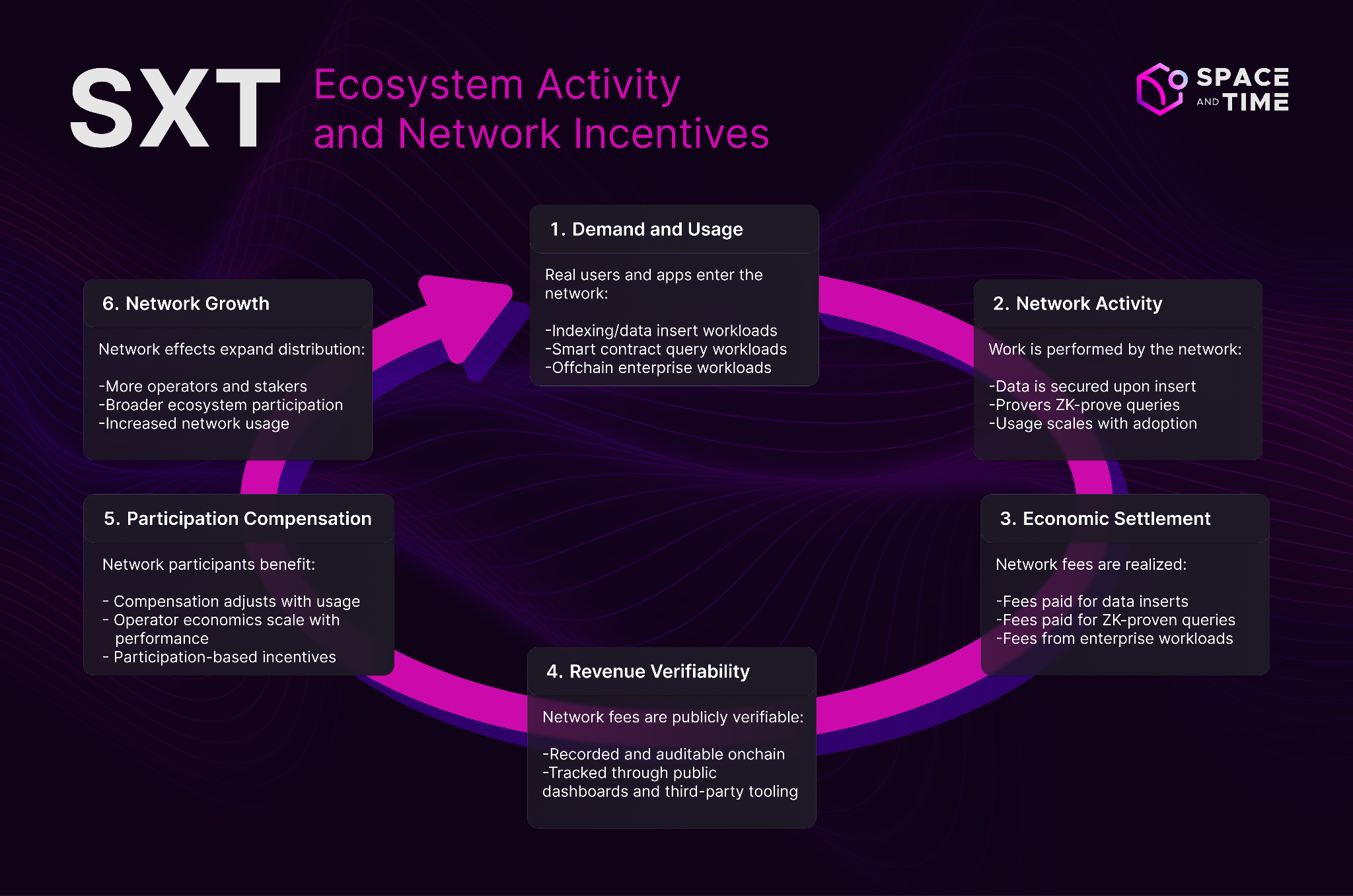
Ecosystem activity and network incentives
1. Demand and usage
The cycle begins with real usage from institutions, enterprises, developers, and applications running production workloads on Space and Time. These workloads include enterprise data pipelines, Proof of SQL queries, and continuous indexing and data services that support live systems and applications.
2. Network activity
As usage compounds on the network, work is performed by indexers, validators, and provers. Queries are executed, proofs are generated and verified, and query results are served to clients. Usage scales directly into network activity, with resource consumption metered and settled at the protocol level.
3. Economic settlement
This activity produces onchain fees through usage-based payments tied to proving, indexing, and data access.
4. Revenue verifiability
Because fees are realized onchain, they are publicly visible and externally verifiable, providing clear signals of adoption and economic health. This visibility is a critical unlock that distinguishes real usage from incentive-driven activity.
5. Participation compensation
As onchain activity grows, compensation for network participants (including staking and validator rewards) is adjusted as a function of actual usage. Operators benefit from participation-based incentives, which scale with performance.
6. Network growth
Increased participation expands the network’s capacity, resilience, and reach. More operators, broader distribution, and deeper ecosystem involvement strengthen the network, enabling it to support additional workloads and larger clients. This expanded capacity feeds back into greater usage, restarting the cycle.
Looking forward
As the Space and Time network continues to scale, growth must be observable, verifiable, and grounded in real network activity. The ability to measure adoption transparently becomes a core part of how the network earns credibility and aligns participants.
Measuring growth transparently
Transparency matters because it aligns usage, performance, and perception around the same set of facts. In the Space and Time network, fees from proving, indexing, and data services are recorded onchain and independently verifiable. Onchain queries execute continuously, participation grows through structured distribution, and public dashboards and aggregators such as DefiLlama surface these metrics over time. Together, these signals provide a grounded view of network progress rooted in observable activity.
Track Space and Time network growth:
Near-term growth catalysts in 2026
The global financial system is increasingly defined by the convergence of offchain financial systems and onchain execution, which, more than ever, will depend on verifiable data. Financial providers also generate persistent, high-frequency data which underpins ongoing systems that must remain correct over time. The partnership with Indomobil Group reflects this reality, where Space and Time supports verifiable data infrastructure for large-scale education and financial processes across Indonesia. These are long-lived workloads that depend on data correctness across jurisdictions, institutions, and settlement environments.
Building on this, the Space and Time Foundation is prioritizing integrations with financial institutions and service providers throughout the year, targeting use cases where data must be consumed and enforced onchain. Stablecoins, tokenized assets, DeFi, and institutional onchain markets all rely on data to function at scale.
Evaluating progress going forward
As Space and Time continues to scale, progress should be evaluated using a consistent set of observable signals. Onchain usage metrics reflect real workload volume. Revenue visibility shows how that usage translates into economic activity. Staking rewards provide insight into how incentives are responding to usage. Active customers and live deployments indicate whether the network is being used in production, while growth in network participation reflects confidence in the system’s long-term operation.
Together, these signals provide a clear framework for understanding how the network is performing. In a financial system defined by data and execution, networks that tie economics to verifiable usage are the ones that endure.
