
User Rewards for Non-Yield-Bearing Stablecoins
The stablecoin market has crossed $300 billion in market cap, and issuers are eyeing a much larger prize: the $6 trillion+ sitting in traditional deposit accounts. Banks attract and retain that capital by paying interest. Stablecoins want to compete, and in many parts of the world, they already are. Yield-bearing stablecoins have grown over 1800% since 2023, offering holders competitive returns that rival traditional savings products. But in the US and EU, it's more complicated.
The GENIUS Act, signed into law in July 2025, prohibits stablecoin issuers from paying interest or yield directly to holders, and the scope of that restriction remains actively debated in Washington. In Europe, MiCA draws an even harder line, banning interest on both e-money tokens and asset-referenced tokens entirely.
The problem: trustless rewards programs are difficult to architect
Issuers who want to operate in these jurisdictions can't simply offer yield, but activity-based rewards, such as cashback on transactions, loyalty programs, and onboarding bonuses, are generally understood to be distinct from interest. While common in traditional finance, the challenge for stablecoin issuers is implementing these rewards in a way that's trustless, verifiable, and not controlled by a single entity, as centralized reward programs create intermediary relationships that add operational and compliance complexity.
Eligibility logic needs to evaluate historical activity across wallets and contracts. Anti-abuse controls need to detect wash trading, sybil attacks, and fake volume. Reward distribution needs to be deterministic and auditable. And the entire system needs to operate without a centralized party making discretionary decisions about who qualifies.
The solution: designing a verifiable incentives layer
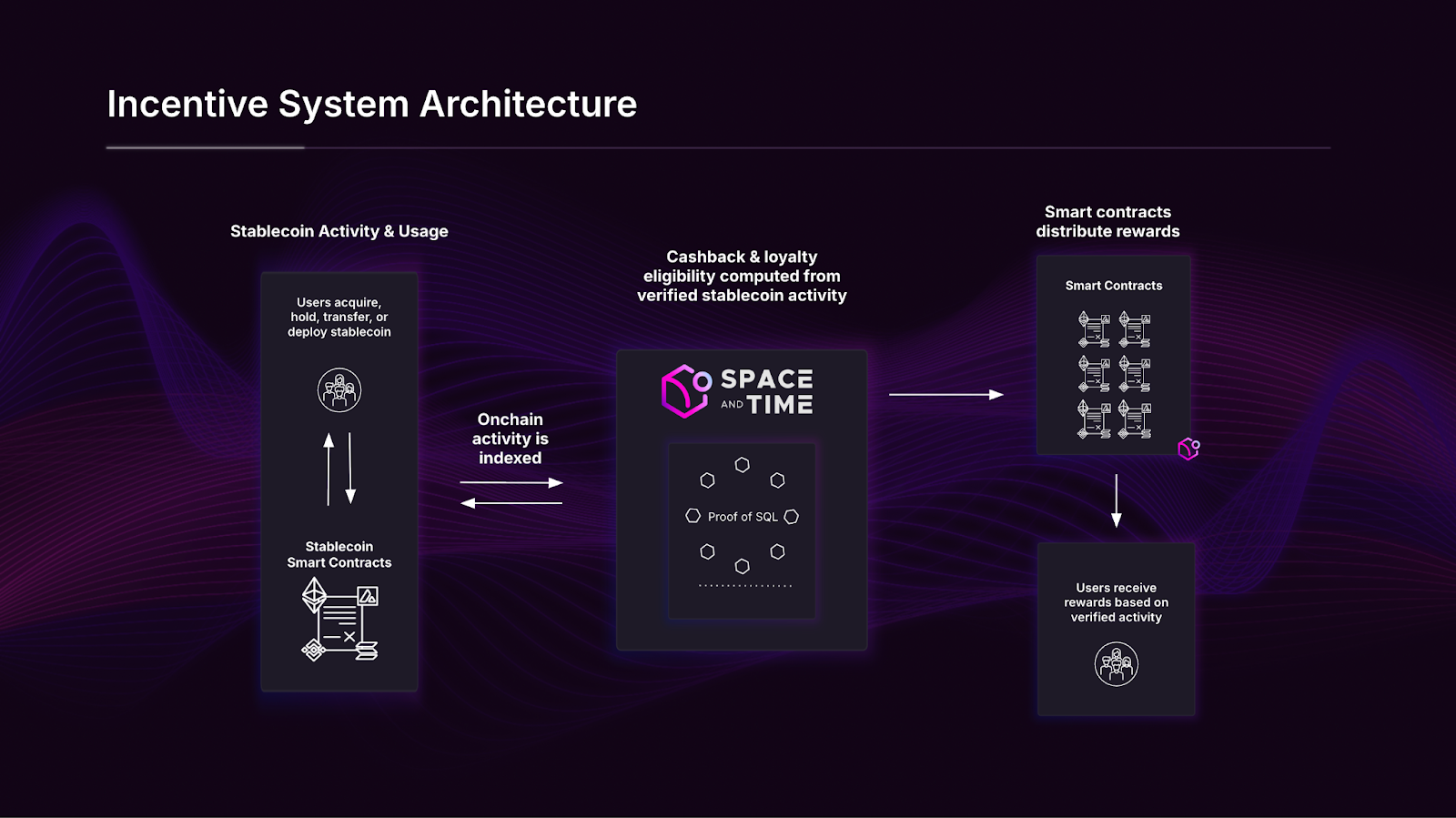
Space and Time, the data blockchain securing onchain finance, provides the infrastructure to build these programs in a trustless, verifiable way. It indexes onchain and offchain activity into a decentralized data network, computes reward eligibility through Proof of SQL (a zero-knowledge proof system that verifies query results are correct, untampered, and auditable onchain), and distributes rewards via smart contracts. No centralized party controls who qualifies or what they receive, and the entire pipeline is auditable onchain.
For stablecoin issuers, this infrastructure enables reward programs that operate entirely outside the stablecoin itself. Nothing changes: no modifications to core smart contracts, no interest rate, no accrual mechanics, no return obligation. The incentive layer runs alongside the stablecoin, rewarding activity without touching the underlying instrument.
What issuers can build: cashback, loyalty, and other rewards programs
Because the incentive layer is programmable and structurally independent from the asset, issuers can tailor reward programs to specific growth objectives.
Cashback programs reward verified stablecoin spend, transfers, and merchant rebates tied to real onchain usage. Eligibility is validated from historical activity with anti-wash controls like average balance logic and onchain campaign caps.
Loyalty and usage programs offer benefits for recurring activity, tenure, and tiered engagement based on genuine behavior. Proof of SQL evaluates rules from verified activity to prevent sybil abuse and fake volume.
Onboarding campaigns provide time-bound bonuses for new users, referrals, and partner activations across the ecosystem. Multi-step conditions are verified externally and executed deterministically by smart contracts.
In each case, eligibility is determined by verified activity rather than a centralized platform's internal logic. Issuers define the rules and budgets, retain control over pause and termination, and benefit from eligibility computations that are externally auditable. Programs can run simultaneously, adjust in real time, and wind down without touching the underlying asset.
How these programs are structured
Unlike yield, there's no promised or guaranteed return. No balance-based interest or accrual mechanics. No compounding yield or reinvestment dynamics. The stablecoin itself doesn't change. Operationally, rewards remain fully discretionary. Programs are capped, time-bound, and adjustable. The issuer defines program parameters without embedding anything into the asset.
The stablecoin remains a monetary instrument. Incentives operate as an external layer with rewards computed from verified onchain data and distributed by smart contracts. The architecture is decentralized and trustless, with no centralized distributor making eligibility decisions.
Getting started
The Space and Time Foundation and its ecosystem partners are actively working with stablecoin issuers to design and deploy reward programs.
Learn how non-yield-bearing stablecoins can still offer trustless rewards with our Stablecoin Rewards solution.
This post is for informational purposes only and does not constitute legal, financial, or regulatory advice. Incentive programs described here are discretionary, external to the stablecoin, and do not represent interest, yield, or any guaranteed return. Consult qualified advisors before implementing any program.
