
Best ZK Coprocessors and Verifiable Compute Layers in 2026: A Comprehensive Comparison

The blockchain industry has long grappled with a fundamental tension: smart contracts require access to rich, complex data in order to power meaningful applications, but onchain computation is prohibitively expensive and limited. Enter ZK coprocessors and verifiable compute layers, a new class of infrastructure that lets developers run complex computations offchain and deliver cryptographically verified results back onchain, all of it without sacrificing trust or decentralization.
But not all ZK coprocessors are created equal. The landscape has matured significantly, and the differences between leading projects now go far beyond theoretical cryptography. They span practical concerns like cost, latency, data availability, cross-chain support, and developer experience. For teams building real-world applications — whether in categories such as DeFi protocols that need historical analytics, loyalty programs that must verify onchain behavior, enterprise systems that blend offchain data with blockchain state, as well as many more — choosing the right verifiable compute layer can make or break the project.
In this guide, we’ll break down the top ZK coprocessors and verifiable compute platforms on the market, comparing them across the dimensions that matter most to developers and product teams. We will look at Space and Time, Brevis, and Axiom — three projects that represent distinct philosophies in the ZK coprocessor space — and examine what sets each apart.
What Is a ZK Coprocessor?
Before diving into comparisons, it is worth establishing a shared understanding of what ZK coprocessors actually do! At a high level, a ZK coprocessor takes data (typically blockchain data, but sometimes offchain data as well), runs a computation over it, and produces a zero-knowledge proof that the result is correct. That proof can then be verified onchain cheaply, allowing smart contracts to act on the result with the same trust guarantees as if the computation had been done onchain (but at a fraction of the cost!).
The key value proposition is straightforward: you get the power of complex, data-rich computation at drastically less than the onchain cost, while retaining cryptographic guarantees of correctness. This enables mechanics that would be otherwise completely impractical on a blockchain, such as querying historical transaction data across thousands of blocks, performing aggregations and joins across multiple tables, or blending onchain data with offchain sources.
However, the devil is in the details: How much data can you access? How fast does the proof come back? What does it cost? Can you work with offchain data, or are you limited to blockchain state? These are the questions that separate a theoretical breakthrough from a truly production-ready tool.
The Contenders
Space and Time (SXT): The Full-Stack Verifiable Compute Layer
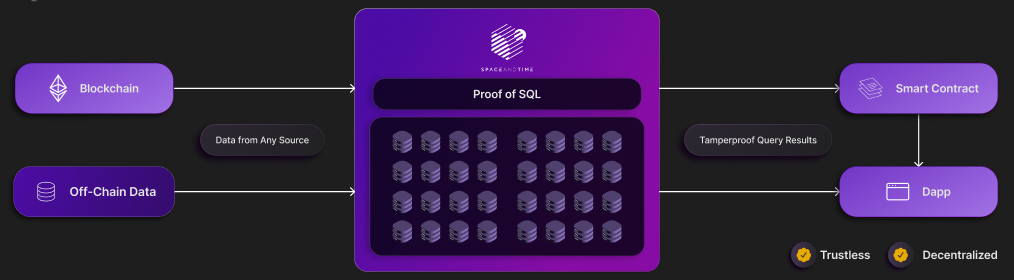
Space and Time has taken the most ambitious approach in the ZK coprocessor space: Rather than narrowly focusing on proving specific onchain state lookups, SXT has built a full verifiable database and compute layer. At its core, SXT allows developers to write standard SQL queries against a rich, multi-chain and offchain indexed dataset and then automatically generates a zero-knowledge proof that the query result is correct.
This is a fundamentally different model from most ZK coprocessors. With SXT, one is not writing circuits or defining custom proof logic; instead, one is writing SQL, and the system handles proof generation transparently. This alone represents a massive reduction in developer complexity, but the advantages go much deeper than that.
Data Sources and Multi-Chain Coverage: SXT supports 75 chains, including Ethereum, all major L2s, and chains supported through Chainlink's CCIP network for proof computing. Critically, in addition to blockchain data, SXT also supports custom database tables; this enables developers to ingest offchain data, combine it with onchain state in a single query, and prove the result, a capability that no other ZK coprocessor in the market currently offers at such a level of maturity.
Cost Structure: SXT uses a pay-per-proof model with low, transparent pricing. Costs scale with the size of the data and the complexity of the query (number of rows, joins, etc.), which ensures that simple queries remain cheap while heavy analytics pay proportionally more. This model ensures that costs align with value.
Performance: Typical latency for SXT ranges from 6 to 12 seconds, depending on query complexity and the time required for block completion. For typical production use cases, this is well within acceptable bounds.
Operations and Data Types: SXT supports the full range of SQL operations one would expect from a production database: joins, aggregations, subqueries, and more. The supported data types are comprehensive: booleans, integers of various sizes (8-bit through 128-bit), decimals, varchar, varbinary, and timestamps. This breadth enables developers to model virtually any business logic without data-type limitations or the need for workarounds.
Developer Experience: Perhaps SXT's greatest advantage is simplicity. Because SXT handles proof generation automatically behind the SQL interface, developers do not need to learn circuit design, constraint systems, or any ZK-specific tooling. If you can write SQL, you can build with SXT. This dramatically lowers the barrier to entry and allows teams to go from concept to production without hiring specialized cryptography engineers.
Brevis: Lightweight On-Demand Proofs
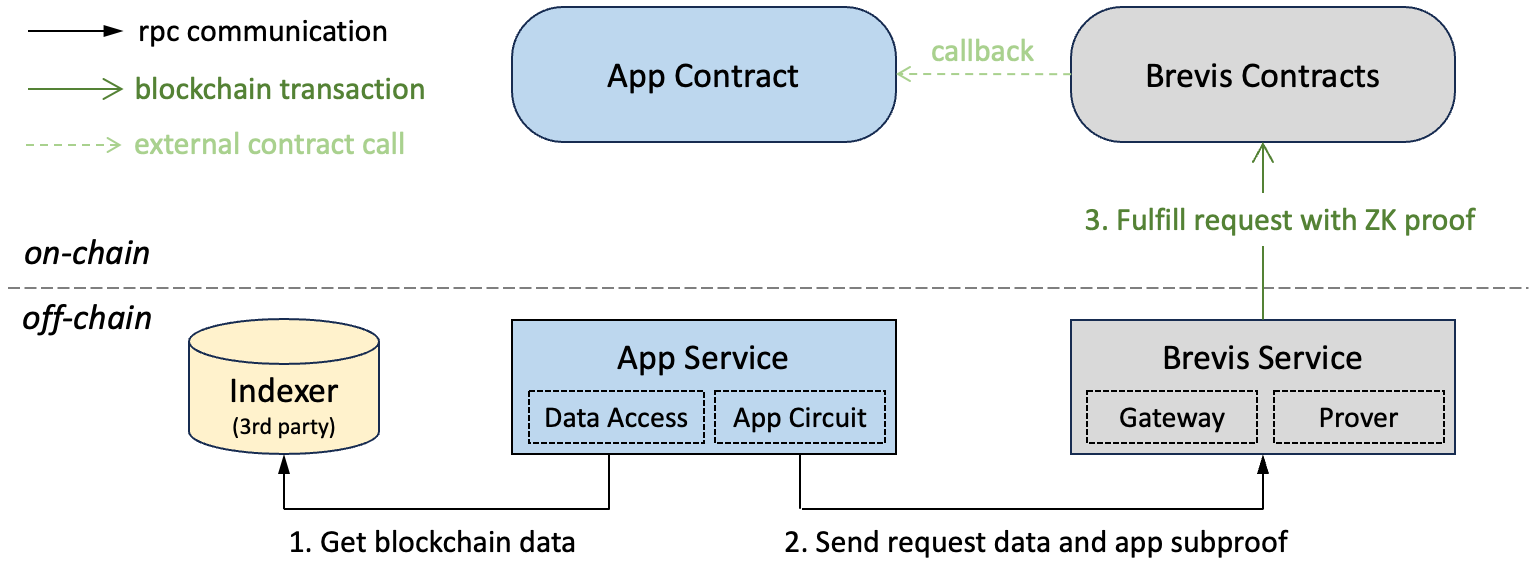
Brevis takes a more focused approach to ZK coprocessing. Rather than maintaining a persistent, queryable database, Brevis fetches data on demand and generates proofs for specific computations. This makes it well-suited for certain narrow use cases, but comes with significant trade-offs at scale.
Data Sources: Brevis supports Ethereum and EVM-compatible L2 chains. It does not support offchain data, nor does it maintain persistent indexed data; instead, everything is fetched at query time from major blockchains.
Cost Structure: The pricing model is opaque, and costs grow significantly with query complexity. Because data is fetched on demand rather than pre-indexed, it is difficult for developers to predict what a given proof will cost before running it, presenting a real problem when budgeting for production workloads.
Performance: Latency is directly tied to the number of data points being proven. For 64 data points, expect 58 to 69 seconds. For 256 data points, 68 to 81 seconds. At 1,024 data points, latency climbs to 127 to 144 seconds, and at 4,096 data points, 323 to 350 seconds (nearly six minutes). This degree of latency makes Brevis impractical for queries that need to scan large datasets or perform complex multi-table joins.
Operations and Data Types: Brevis supports a limited set of operations and notably lacks bitwise operations entirely. Supported data types include Uint248, Uint521, Int248, and Bytes32, a narrower set than what SXT offers. Complex queries involving multiple tables, large joins, or diverse data types are challenging to express within Brevis's constraints.
Developer Experience: Brevis requires developers to define or generate circuits as part of the proof setup process. This adds significant complexity compared to SXT's approach. Developers need to understand circuit design concepts and work with the Brevis Circuit SDK, which creates a steeper learning curve, longer development cycles, and potentially higher personnel costs.
Cross-Chain Support: Brevis does support cross-chain reads within the EVM ecosystem, a very useful capability for multi-chain applications. However, the scope of supported chains is limited compared to SXT's 75-chain coverage.
Axiom: Deep Ethereum State Proofs
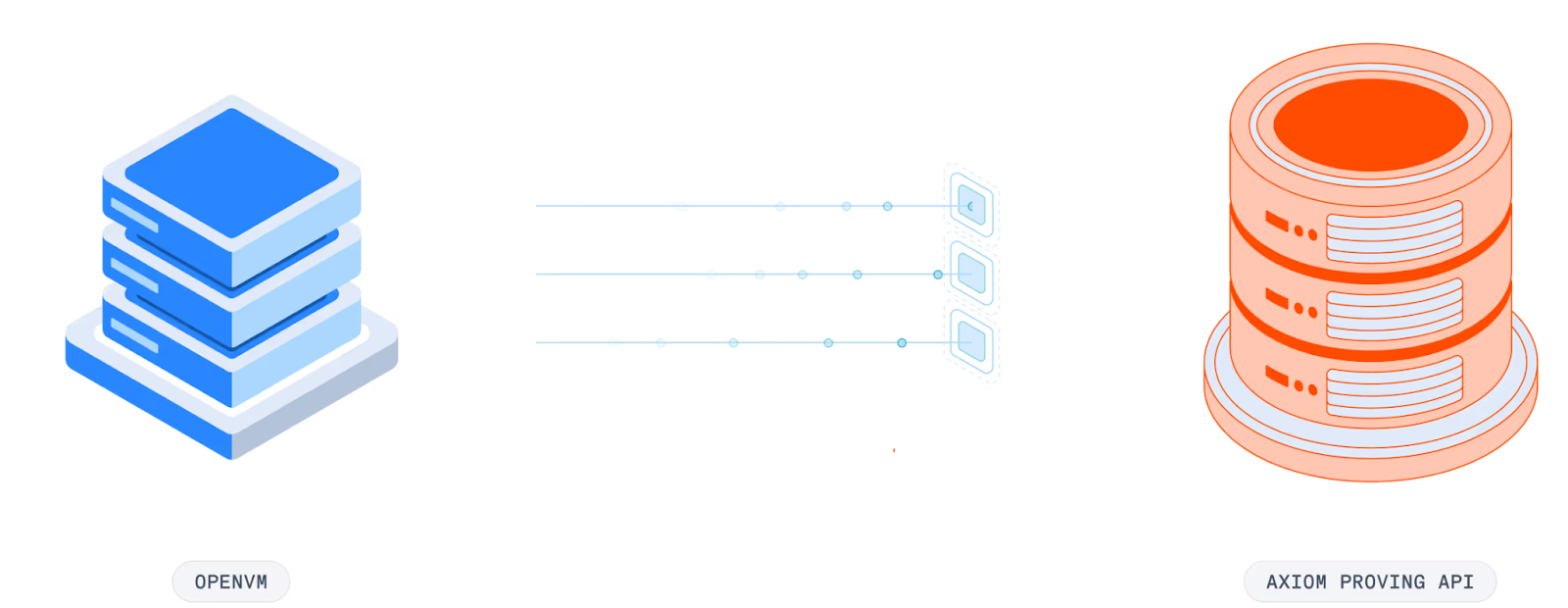
Axiom has carved out a niche as a specialist in proving Ethereum historical state. It excels at generating proofs for very specific, granular claims about Ethereum's blockchain history, things like "This storage slot had value X in block N" or "These 50 transactions really occurred."
Data Sources: Axiom is focused almost exclusively upon Ethereum historical state; it can prove storage slots, transaction existence, event logs, and account balances at specific block heights. This is powerful for Ethereum-native use cases but severely limiting for applications that need multi-chain data, offchain data, or general-purpose computation.
Cost Structure: Axiom charges approximately $0.01 per block, with costs tied to the number of storage slots touched. This can be very cheap for simple state lookups, but it scales unpredictably as queries grow in complexity.
Performance: Axiom delivers proofs in six to 12 seconds, making it the fastest of the three for its supported use cases. However, this speed comes at the cost of scope; Axiom is fast precisely because what it does is so limited.
Operations and Data Types: Axiom supports Ethereum primitives: uint256, bytes32, bytes, Merkle inclusion proofs, and addresses. This is sufficient for proving raw blockchain state, but it’s inadequate for serving business logic that requires non-simple data types or complex query operations.
Developer Experience: Like Brevis, Axiom requires developers to define circuits for proof generation. This adds substantial complexity to app development and demands specialized knowledge that most teams do not have in-house.
Cross-Chain and Offchain Support. Axiom does not support offchain data or cross-chain reads. It is an Ethereum-only tool, which limits its applicability both for the growing number of applications that span multiple chains and any applications that require access to offchain data.
Head-to-Head Comparison
When one compares the three platforms side by side, the differences become stark.
Breadth of Data Access: SXT leads by a wide margin with 75 indexed chains plus offchain data support. Brevis covers Ethereum and EVM L2s. Axiom covers Ethereum only.
Query Complexity: SXT supports full SQL with joins, aggregations, and subqueries across multiple tables. Brevis struggles with complex queries and large joins. Axiom is limited to state proofs and Merkle inclusion patterns.
Latency: All three platforms deliver proofs in seconds to minutes. SXT ranges from six to 30 seconds. Axiom is fastest at six to 12 seconds but covers a far narrower scope of functions. Brevis is slowest, ranging from about a minute for small queries to nearly six minutes for larger datasets.
Cost Predictability: SXT offers transparent, usage-based pricing that scales with data and query complexity. Brevis has an opaque pricing model wherein costs grow unpredictably with complexity. Axiom charges per block, with costs tied to slots touched.
Developer Experience: SXT is the clear winner here. Writing SQL versus writing circuits is not a marginal difference; instead, it is the difference between a developer shipping a feature in a day versus spending weeks learning circuit design and debugging constraint systems or, alternatively, incurring the cost of hiring specialized personnel.
Offchain Data: Only SXT supports blending offchain data with onchain state in a single verified query. This is a dealbreaker for many real-world use cases that need to combine blockchain data with business data, oracle feeds, or external APIs.
Cross-Chain Reads: SXT supports cross-chain queries natively across 75 chains. Brevis supports cross-chain reads within the EVM ecosystem. Axiom does not support cross-chain reads of any kind.
Which Should You Choose?
The answer depends upon your use case, but for most production applications, Space and Time offers the most complete and developer-friendly solution.
If you are building an application that needs to query complex, multi-chain data, blend onchain and offchain sources, or run SQL-style analytics with verifiable results, SXT is the best choice. Its combination of broad data access, full SQL support, automatic proof generation, and transparent pricing makes it the most production-ready platform in the space.
Brevis may make sense if you have a very simple, single-chain eligibility check; for example, proving that a wallet held a certain token at a specific time. But as soon as your requirements grow beyond that narrow scope, you will likely hit the barriers of its limited query capabilities and longer proof times.
Axiom is the right tool if you specifically need deep Ethereum state proofs that prove exact storage slot values or transaction existence at specific block heights; it is fast and cheap for that narrow use case. But it is not a general-purpose compute layer, and its Ethereum-only focus sharply limits its applicability as the multi-chain ecosystem continues to expand.
The Bottom Line
The ZK coprocessor market is maturing, and the gap between platforms is widening. Space and Time has positioned itself as the full-stack verifiable compute layer, the platform that does not force one to choose between data richness, query power, developer simplicity, and multi-chain support. For teams that want to build real, production-grade applications with verifiable offchain computation, SXT represents the most complete solution available today.
As the blockchain industry continues to move toward a multi-chain, data-rich future, the ability to query, compute, and prove across diverse data sources will become table stakes. Projects that invest in breadth, developer experience, and production readiness today will define the standard for verifiable compute tomorrow. On that front, Space and Time is leading the way.
