
Axiom ZK Coprocessor vs. Space and Time: Which Verifiable Compute Platform Is Right for You?

The ZK coprocessor landscape has evolved rapidly, and developers now face a genuine choice between platforms with meaningfully different capabilities. Two projects that frequently come up in infrastructure evaluations are Axiom and Space and Time (SXT). Both leverage zero-knowledge proofs to deliver verifiable computation results onchain, but the similarities largely end there; the two differ greatly in architecture, scope, developer experience, and the range of applications they can support.
Axiom has built a reputation as a specialist in Ethereum historical state proofs, a focused tool that does one thing well. Space and Time has taken a broader approach, building a full verifiable compute layer with a multi-chain indexed database, SQL-native querying, and automatic proof generation. The two represent fundamentally different answers to the question of what a ZK coprocessor should be.
In this comprehensive comparison, we examine Axiom and Space and Time across every dimension that matters for production development: data access, chain coverage, cost, latency, query capabilities, data types, cross-chain support, and developer experience. Whether you are building a simple Ethereum state proof or a complex multi-chain analytics application, this guide will help you understand which platform fits your needs.
Architectural Foundations
The architectural differences between Axiom and SXT set the stage for everything that follows.
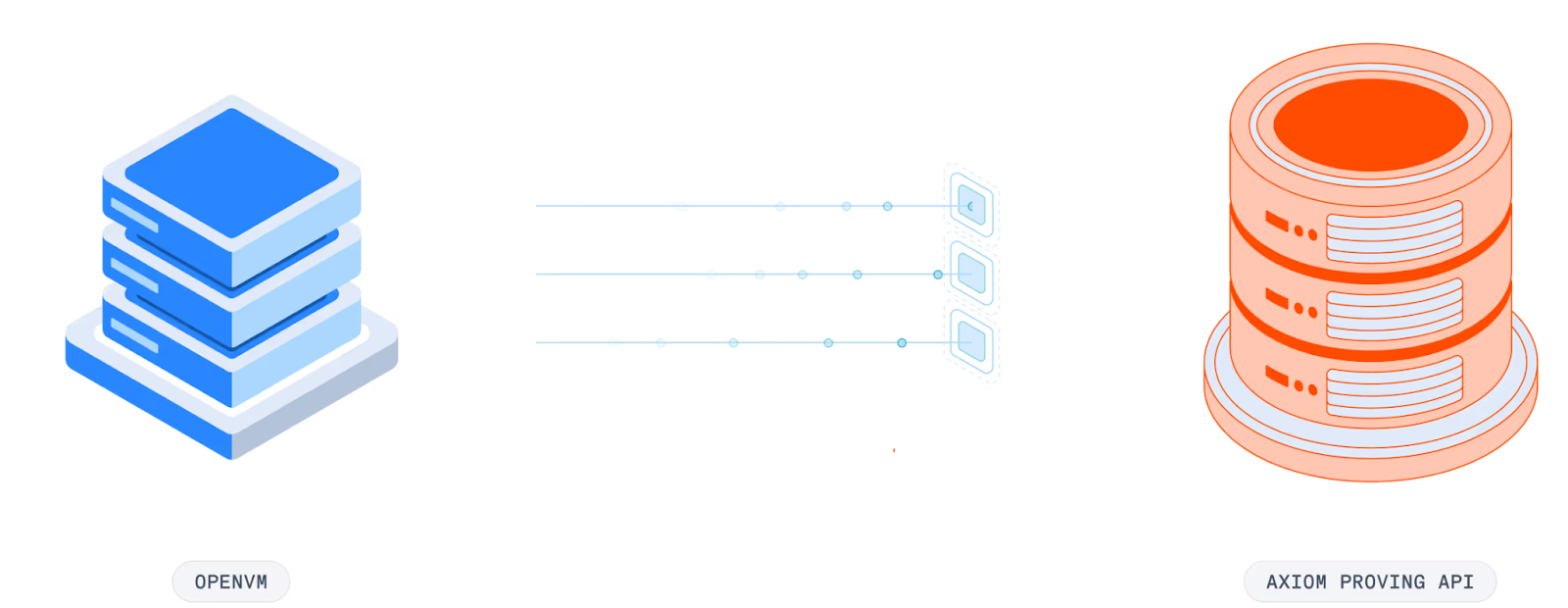
Axiom is designed around Ethereum's Merkle Patricia Trie structure. It generates ZK proofs that specific pieces of Ethereum state existed at specific block heights. Think of Axiom as a cryptographic magnifying glass for Ethereum's history: it can prove that a particular storage slot held a particular value at a particular block, that a specific transaction occurred, or that an event log exists. This is a powerful tool for a narrow category of use cases, but Axiom's architecture is inherently tied to Ethereum's state model.
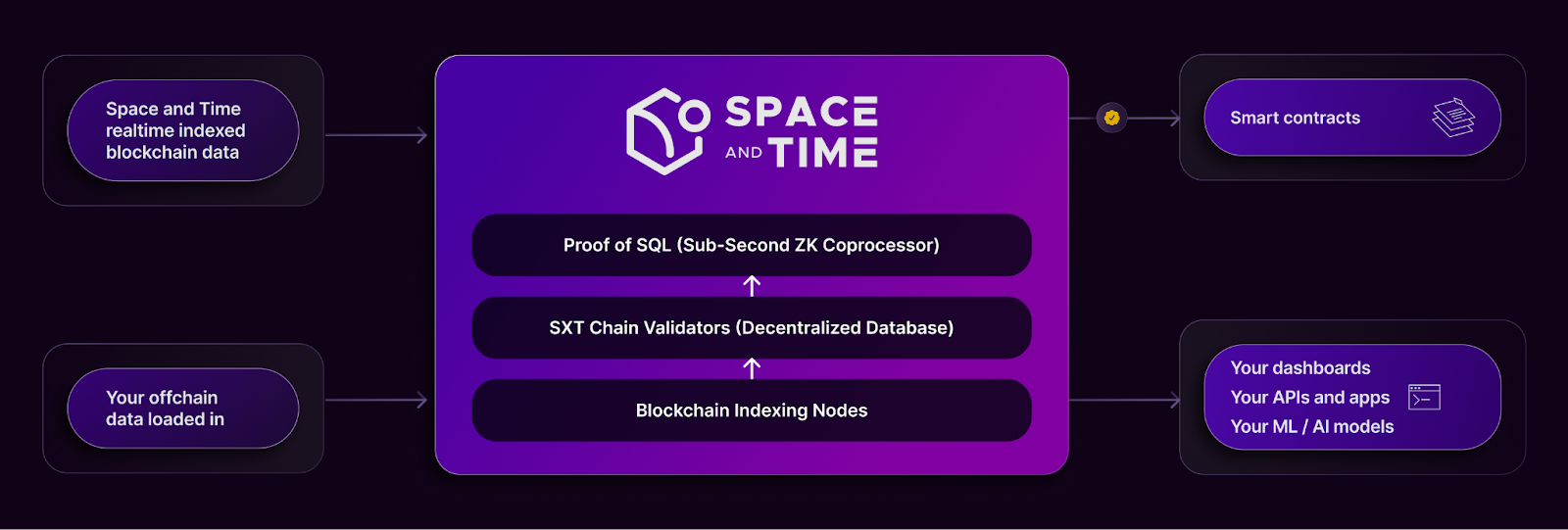
Space and Time is built on a relational database architecture with an integrated ZK proof engine called Proof of SQL. SXT indexes all major blockchains and smart contracts, continuously ingesting onchain data into a queryable database. In addition to blockchain data, developers can also create custom tables and ingest offchain data. When a developer runs a SQL query against this database, SXT automatically generates a zero-knowledge proof that the query was executed correctly over the underlying data and that this data has not been tampered. Verified results can then be served to every chain supported through Chainlink's CCIP network. There is no circuit design step, as the proof generation is handled entirely by the platform.
This all means that Axiom is limited to answering questions like "What was the value of storage slot X at block N?" while SXT can answer a much broader scope of questions such as "What was the total trading volume for addresses that held token Y across chains A, B, and C in the last 30 days, combined with their offchain loyalty tier data?" The difference in scope is immense.
Data Sources and Chain Coverage
The range of data a ZK coprocessor can access directly determines the scope of applications that can be built with it.
Axiom is focused almost exclusively on Ethereum historical state. It can access and prove storage slots, account balances, transaction data, and event logs from Ethereum's history. This is a deep but narrow data source. Axiom excels at proving statements such as "This storage slot had value X in block N," "These 50 transactions really occurred," "This address balance was Y at that time," or "This event log exists." These are valuable capabilities for Ethereum-native applications, but they represent only a small slice of the data most modern applications require.
Axiom does not support offchain data, nor does it does support cross-chain reads. If your application needs data from Arbitrum, Base, Polygon, Solana, or any chain other than Ethereum, Axiom cannot provide it.
Space and Time indexes all major blockchains and smart contracts, with verified results served to every chain supported through Chainlink's CCIP network. This multi-chain dataset is continuously updated, meaning developers always have access to both current state and historical data. Critically, in addition to blockchain data, SXT supports custom database tables where developers can ingest and store offchain data from any source. This data can be queried alongside onchain state in a single SQL query, with the entire result backed by a ZK proof. This is a capability that no other ZK coprocessor in the market currently offers at this level of maturity.
Verdict: SXT's data access capabilities far exceed Axiom's in both breadth and flexibility. Axiom is Ethereum-only with no offchain support. SXT covers all major chains plus offchain data. For any application that needs more than Ethereum state proofs, this is a fundamentally key difference between the two.
Cost Comparison
Pricing models differ significantly and have real implications for production budgets.
Axiom charges approximately $0.01 per block, with costs tied to the number of storage slots or data points touched in a given proof. For simple state lookups — proving a single storage value at a single block — this is extremely cheap. However, costs scale with the number of slots accessed, and the relationship between query complexity and cost can be unpredictable for applications that need to touch many data points across many blocks.
Space and Time uses a transparent, usage-based pay-per-proof model. Costs grow with the number of rows processed and the complexity of joins and aggregations. This model scales predictably; users can estimate costs before running queries, which is essential for production budgeting.
Verdict: Though Axiom can be cheaper for very simple, single-block Ethereum state lookups. SXT's pricing model is more predictable for complex queries, and the value you get per proof — full SQL query results across multiple chains with offchain data — is fundamentally superior. When you compare cost per unit of useful information rather than cost per raw proof, SXT offers much more compelling value.
Performance and Latency
Both platforms deliver proofs in seconds, but the context matters.
Axiom delivers proofs in six to 12 seconds. This makes it the quickest option for its supported use cases. However, this speed is partly a function of the Axiom’s narrow functional scope; Merkle inclusion proofs over Ethereum state are inherently less complex than full SQL query proofs over multi-chain datasets.
Space and Time delivers proofs in six to 30 seconds, depending on query complexity and block finality timing. The lower end of this range is competitive with Axiom, and the upper end reflects the far broader computation involved in proving complex SQL queries over larger datasets. For production applications, a 30-second proof time for a complex multi-table, multi-chain query is excellent performance.
Verdict: Axiom is marginally faster for simple Ethereum state proofs. SXT is comparable at the low end and delivers far more complex proofs within a very reasonable time frame. The small latency advantage Axiom holds does not compensate for the dramatically lower scope of what its proof actually contains.
Query Capabilities and Operations
This is where the gap between the two platforms becomes most apparent.
Axiom operates at the level of Ethereum primitives. It can prove only storage slot values, account balances, transaction inclusion, and event log existence. These are valuable building blocks, but they are not queries in the traditional sense. One cannot ask Axiom to aggregate data across blocks, join information from different contracts, or compute derived metrics. Each proof corresponds to a specific state assertion — that is, "this value was X at block N" — rather than a computed result over a dataset.
Axiom's supported data types reflect this primitive-level focus: uint256, bytes32, bytes, Merkle inclusion proofs (bytes32 arrays), addresses (as fixed bytes), and storage fields from contracts. These are the raw types of Ethereum state, not the data types you would use to model business logic.
Space and Time supports the full range of SQL operations including SELECT, WHERE, JOIN, GROUP BY, ORDER BY, subqueries, and aggregation functions. Developers can model complex business logic using familiar relational database patterns. The supported data types are comprehensive and production-ready: booleans, integers from 8-bit TinyInt through 128-bit Int128, decimals, varchar for strings, varbinary for binary data, and timestamps for time-series operations. This system can model virtually any business domain without workarounds.
Additionally, SXT supports streaming events directly into tables, meaning developers can set up automated data pipelines that continuously feed onchain events into queryable tables without manual intervention.
Verdict: SXT operates at a level of query capability far superior to that of Axiom. Axiom merely proves state assertion; SXT answers complex analytical questions. For any application that needs computed results rather than raw state proofs, SXT is the only viable option.
Developer Experience
How easy it is to build with a platform determines how quickly one can ship an app and how much it costs to maintain.
Axiom requires developers to define circuits for proof generation. This means working with circuit-level abstractions, understanding constraint systems, and debugging at a layer that most software engineers are unfamiliar with. While Axiom has invested in documentation and tooling to make this process more approachable, circuit design remains a fundamentally specialized skill. Teams without ZK cryptography expertise will face a significant learning curve, and the resulting code is harder to review, test, and maintain than standard application logic.
Space and Time eliminates the circuit design requirement entirely. Developers write standard SQL queries, and proof generation is handled automatically by the Proof of SQL engine. There is no circuit SDK to learn, no constraint system to reason about, and no ZK-specific debugging. A backend developer who knows SQL can be productive with SXT on day one. This dramatically reduces the specialized talent required, shortens development timelines, and lowers the ongoing maintenance burden.
Verdict: SXT offers a fundamentally simpler developer experience. The difference between writing SQL and writing circuits is not incremental; it is a paradigm change in accessibility and development speed.
Cross-Chain Support
As the blockchain ecosystem continues to fragment across L1s and L2s, cross-chain capabilities become increasingly critical.
Axiom does not support cross-chain reads. It is an Ethereum-only tool. If your application needs to reference data from any chain other than Ethereum, you cannot use Axiom for that component of the computation. Settlement is also focused primarily on Ethereum.
Space and Time supports cross-chain queries natively across all its indexed chains. Because all chain data is stored in a unified relational database, a single SQL query can reference tables from multiple chains simultaneously. Settlement is also broadly supported, with integration into Chainlink's CCIP network providing cross-chain proof delivery capabilities.
Verdict: SXT's cross-chain capabilities are vastly superior. For any application that spans multiple chains — which is an increasingly common pattern in modern blockchain development — Axiom simply does not compete.
Offchain Data Support
The ability to combine onchain verification with offchain data is becoming essential for real-world applications.
Axiom does not support offchain data in any form. All proofs must be generated over Ethereum state data.
Space and Time fully supports offchain data through custom database tables. Developers can ingest data from any external source — databases, APIs, files, streaming services — and query it alongside onchain data in verified SQL queries. This hybrid capability enables an entirely new class of hybrid applications that bridge the blockchain and traditional data worlds.
Consider an insurance protocol that needs to verify onchain claim events against offchain weather data, or a gaming platform that combines onchain asset ownership with offchain gameplay statistics. These hybrid use cases are possible only with a platform that supports both data types; in the current market, SXT is uniquely positioned to deliver this.
Verdict: SXT's offchain data support is a differentiating capability that Axiom does not offer on any level. For hybrid use cases, this alone can determine platform choice.
When to Choose Each Platform
Despite the clear advantages of SXT across most dimensions, there are specific scenarios where each platform makes sense.
Choose Axiom when:
- You need to prove a specific piece of Ethereum state at a specific block height
- Your use case is limited to Ethereum and does not require multi-chain data
- You are comfortable with circuit design and want fine-grained control over proof logic
- You need the fastest possible proof time for simple state assertions
- Your application does not require complex queries, joins, or aggregations
- Offchain data is not part of your requirements
Choose Space and Time when:
- You need to query data across multiple chains
- Your application requires SQL-level query capabilities (joins, aggregations, filtering)
- You need to combine onchain and offchain data in verified queries
- Developer simplicity and time to market are priorities
- You need sub-30-second proofs for complex queries
- You are building for production scale with predictable costs
- You need broad cross-chain settlement capabilities
- Your data types go beyond mere Ethereum primitives (strings, timestamps, decimals)
The Bigger Picture
The comparison between Axiom and Space and Time illustrates a broader evolution in the ZK coprocessor space. Early ZK coprocessors were, by necessity, narrow and specialized — proving specific state assertions with custom circuits. This was a valuable first step, and projects like Axiom helped establish the category and demonstrate its potential.
But the market's needs have grown. Modern blockchain applications are multi-chain by default. They need to process complex data, not just verify raw state. They need to integrate with offchain systems. And the developer teams building them often cannot afford to hire circuit specialists for every feature. The ZK coprocessor that wins the market will be the one that meets developers where they are, namely with familiar tools, broad data access, and production-ready performance.
Space and Time represents this next phase of verifiable compute. By building on a relational database architecture with SQL-native querying and automatic proof generation, SXT has created a platform that is both more powerful and more accessible than its predecessors. It does not ask developers to become cryptographers. It asks them only to write SQL.
Conclusion
Axiom and Space and Time are both valuable contributions to the ZK coprocessor ecosystem, but they are not interchangeable. Axiom is a specialized tool for Ethereum state proofs; precise, fast, and focused. Space and Time is a comprehensive verifiable compute layer; broad, powerful, and developer-friendly.
For the narrow use case of proving Ethereum state at specific block heights, Axiom is a capable and efficient choice. For virtually everything else — multi-chain queries, complex analytics, offchain data integration, production applications at scale, and so on — Space and Time offers a fundamentally more complete solution.
The trajectory of the blockchain industry points clearly towards a future of multi-chain, data-rich applications that blend onchain verification with real-world data. In that future, the ability to query, compute, and prove across diverse data sources using familiar developer tools will not be optional; it will be essential. Space and Time is building for that future today, and the gap between its capabilities and those of more narrowly focused alternatives like Axiom will only continue to widen.
